Why Your Newer AC Is Spiking Bills & How Our Tune‑Up Helps
Newer AC but rising electric bills? We explain common hidden issues that hurt efficiency and how our professional tune‑up can help bring your energy costs back down.
When a Newer AC Sends Your Electric Bill Through the Roof
We recently got a call from a customer — let’s call him Mark — who sounded pretty frustrated. We had installed a brand‑new AC system for him, inside and out, about three years ago. Lately, though, his electric bill had almost doubled.
Mark told us, “All signs point to the AC. It feels like it’s running all the time. I’m worried it might be low on Freon, and I know that usually means a leak.” He wanted us to come out, inspect the system, and get it “up and running right” again.
We hear this kind of concern a lot: “Why is my newer AC system causing such high electric bills?” The good news is, in our experience, a professional tune‑up almost always finds a fixable cause and can bring those bills back under control.
Why a Newer AC Can Still Cause High Electric Bills
It’s easy to assume that a three‑ to five‑year‑old system should still be running like new. But we see the same patterns over and over when we’re called out for high‑bill complaints on newer systems.
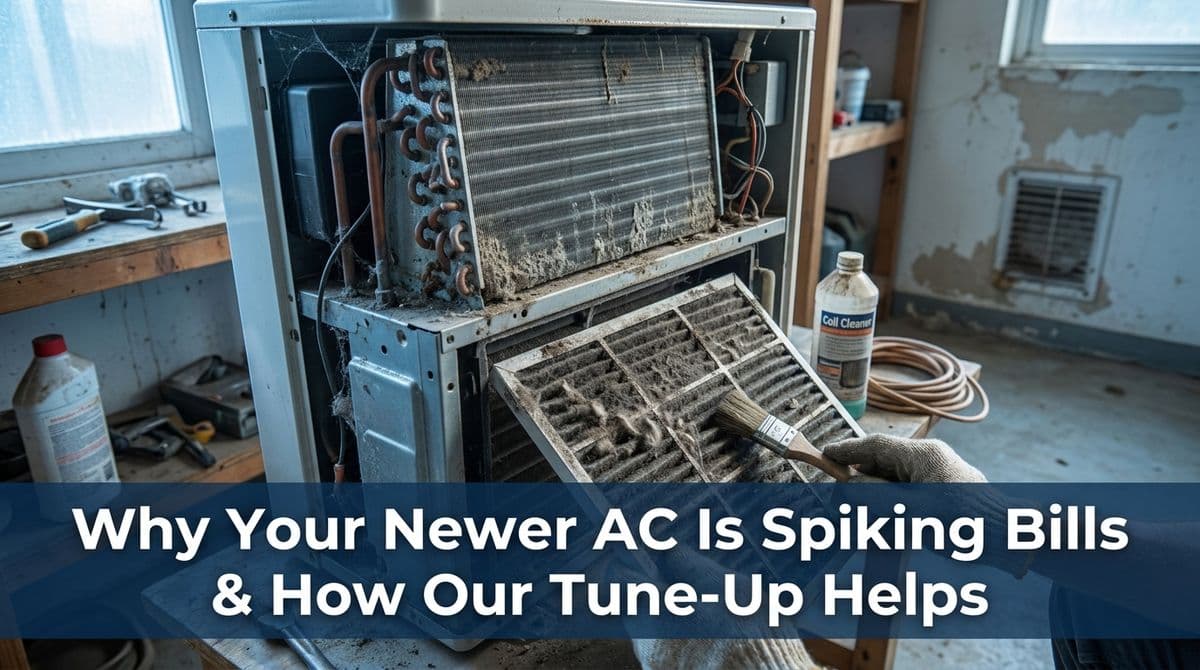
1. Dirt, Dust, and Grime Strangling Airflow
By the time a system is a few years old, we usually find:
- Dirty air filters that haven’t been changed regularly
- Dusty indoor coils that can’t transfer heat efficiently
- Clogged outdoor coils from grass clippings, cottonwood, or pet hair
When airflow is restricted, your AC has to run longer to cool the same space. From our side of the gauges, we see a big difference in run time and energy use before and after we clean these components.
2. Refrigerant (Freon) Issues — Not Always a “Big Leak”
Like Mark, a lot of folks jump straight to, “It must be low on Freon.” Sometimes they’re right, but not always. When we check a system, we look at pressures, temperatures, and superheat/subcooling to see what’s really going on.
If the refrigerant charge is even a little off — too low or too high — the system loses efficiency and costs more to run. A small, slow leak can take a couple of years to show up as higher bills, which is exactly the kind of situation we check for during a tune‑up.
3. Thermostat and Settings Working Against You
We often find that the thermostat settings are part of the problem. Here’s what we look for in your home:
- Big temperature swings (setting it to 78°F during the day and 68°F when you get home)
- “Hold” mode misused, which can override efficient schedules
- Thermostat location in direct sunlight or near heat sources
In many homes, we can improve comfort and lower bills just by adjusting schedules and explaining how to use the thermostat’s features properly.
4. Duct Problems You Can’t See
We also check the ductwork when we’re diagnosing high bills. In our experience, even newer systems can suffer from:
- Loose or leaky joints in the attic
- Kinked or crushed flex ducts restricting airflow to certain rooms
- Poorly insulated ducts that lose cool air in a hot attic
All of these force your newer AC to work harder, which shows up as higher energy usage every month.
What We Actually Do During a Professional AC Tune‑Up
When Mark booked his service visit, he wanted to know what we’d be doing besides “just looking at it.” That’s a fair question. A real tune‑up is much more than a quick spray‑off of the unit.
Here’s what we look for and do on a typical visit
When we come to your home for a cooling tune‑up, we:
- Inspect and clean the outdoor unit — remove debris, clean the condenser coils, and check the fan.
- Check the indoor unit — inspect the evaporator coil, blower wheel, and drain line for clogs and buildup.
- Measure refrigerant levels using gauges and temperature readings to see if the charge is correct.
- Test electrical components like capacitors, contactors, and motors for signs of wear that can hurt efficiency.
- Verify temperature drop across your system (the difference between return and supply air) to confirm it’s cooling properly.
- Check airflow and look for signs of duct leaks or restrictions.
- Review thermostat settings with you and recommend money‑saving schedule tweaks.
By the end of the visit, we can usually point to a few specific things that were driving your bill up and explain what we did to correct them.
What to Expect From Us When We Service Your Newer AC
We know it’s stressful when your bill spikes and you’re worried something major is wrong. When we come out to your home, our goal is to give you clear answers and practical options, not just confusing technical jargon.
Here’s how we typically walk you through the appointment:
- Start with your concerns — we ask when you noticed the bill climb, how the system has been performing, and any hot or cold spots.
- Perform a full system evaluation — outside unit, inside unit, ducts (as accessible), and thermostat.
- Show you what we find — when possible, we point out dirty coils, worn parts, or duct issues so you can see what we see.
- Prioritize recommendations — we explain what must be fixed now versus what can be planned for later.
- Discuss energy‑saving tips tailored to your home, habits, and system.
We want you to understand exactly why your newer AC was running up your electric bill and what we did to help bring that bill back down.
How Often We Recommend AC Tune‑Ups for Newer Systems
Homeowners often tell us, “It’s only a few years old, so I didn’t think it needed service yet.” From our side, we see the difference regular maintenance makes, even on newer equipment.
Here’s what we typically recommend for most homes in our climate:
- Every year: One professional cooling tune‑up before peak summer heat.
- Every 1–3 months: Change or clean air filters, depending on pets, allergies, and dust.
- Seasonally: Keep 2–3 feet of clear space around the outdoor unit and gently rinse off visible dirt.
In our experience, systems that get annual tune‑ups have fewer breakdowns, last longer, and keep bills noticeably lower. Skipping maintenance for the first few years often leads to the kind of surprise Mark ran into — a great system that’s quietly losing efficiency and costing more to run.
Simple Steps You Can Take Before We Arrive
While a full tune‑up is our job, there are a few quick checks you can do on your own if your newer AC is driving your bill up:
- Check the air filter and replace it if it looks gray or clogged.
- Walk around the outdoor unit and clear away leaves, grass, or anything blocking airflow.
- Look at your thermostat schedule and avoid big temperature swings — 2–4 degrees between “home” and “away” is usually enough.
If you try those steps and the bills are still high, that’s when we step in with gauges, meters, and experience to track down the root cause.
When Your Electric Bill Doubles, Don’t Ignore It
Mark did exactly the right thing by calling us as soon as he noticed his bill nearly doubling. A newer AC system should be efficient, and if it isn’t, something’s off — but it’s often fixable with a thorough inspection and tune‑up.
If your newer system is running longer, struggling to keep up, or sending your electric bill sky‑high, we’re here to help. When we visit your home, we treat your equipment like our own, track down what’s wasting energy, and get your system back to cooling efficiently so you can stay comfortable without dreading your next bill.